
Kiev old map
You can find on this page the Kiev old map to print and to download in PDF. The Kiev historical map and the vintage map of Kiev present the past and evolutions of the city of Kiev in Ukraine.
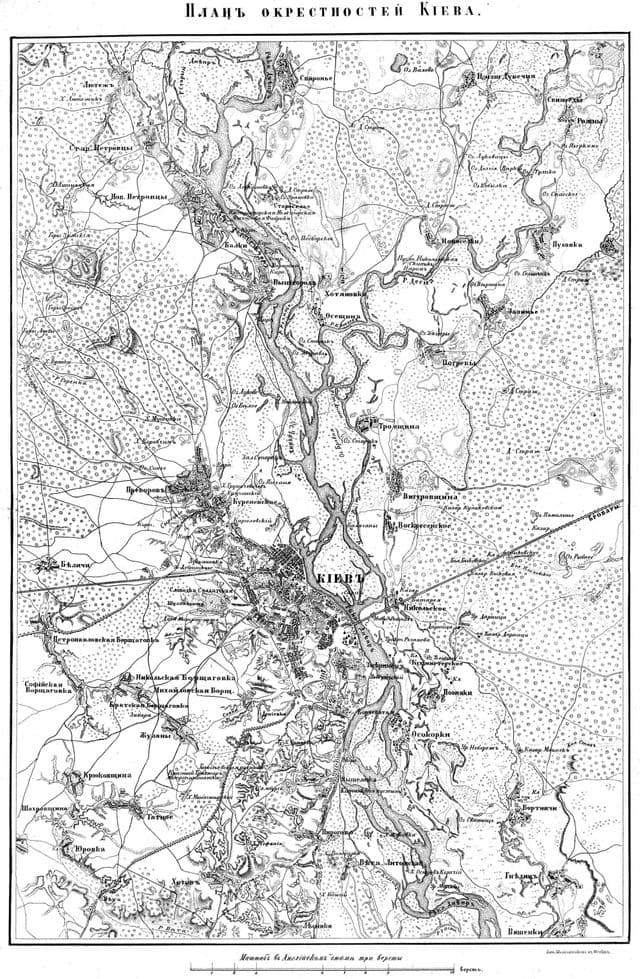
Kiev historical map
The Kiev old map shows evolutions of Kiev city. This historical map of Kiev will allow you to travel in the past and in the history of Kiev in Ukraine. The Kiev ancient map is downloadable in PDF, printable and free.
According to a legend, the historical city of Kiev was founded in the 5th century by East Slavs. The legend of Kyi, Schek and Khoryv speaks of a founder-family consisting of a Slavic tribe leader Kyi, the eldest, his brothers Schek and Khoriv, and also their sister Lybid, who founded the city. Kiev (Kyiv, Київ, in Ukrainian) is translated as “belonging to Kyi”. The non-legendary time of the founding of the city is harder to ascertain (see Kiev historical map). Slavic settlement existed in the area from the end of 5th century, that later developed into the city. Some western historians (i.e. Kevin Alan Brook) speculate that Kiev was founded by Khazars or Magyars. Brook assumes that Kiev is a Turkic place name (Küi = riverbank + ev = settlement).

Kiev vintage map
The Kiev vintage map give a unique insight into the history and evolution of Kiev city. This vintage map of Kiev with its antique style will allow you to travel in the past of Kiev in Ukraine. The Kiev vintage map is downloadable in PDF, printable and free.
In 968 the vintage city withstood a siege by the nomadic Pechenegs. In 988 by the order of the Grand Prince Vladimir I of Kiev (St. Vladimir or Volodymyr), the city residents baptized en-masse in the Dnieper river, an event the symbolized the Baptism of Kievan Rus as its mentioned in Kiev vintage map. Kiev reached the height of its position of political and cultural Golden Age in the middle of the 11th century under Vladimir son Yaroslav the Wise. In 1051, prince Yaroslav assembled the bishops at St. Sophia Cathedral and appointed Hilarion, the first native of the Kievan Rus, as metropolitan bishop, that the decision reflects an anti-Byzantine bias. In 1054, the Kievan Church did not take note of the fact that the East–West Schism began, maintaining very good relations with Rome (i.e. prince Iziaslav I of Kiev request to Pope Gregory VII to extend to Kievan Rus’ “the patronage of St. Peter”, fulfilled by the pope by sending Iziaslav a crown from Rome in 1075).